
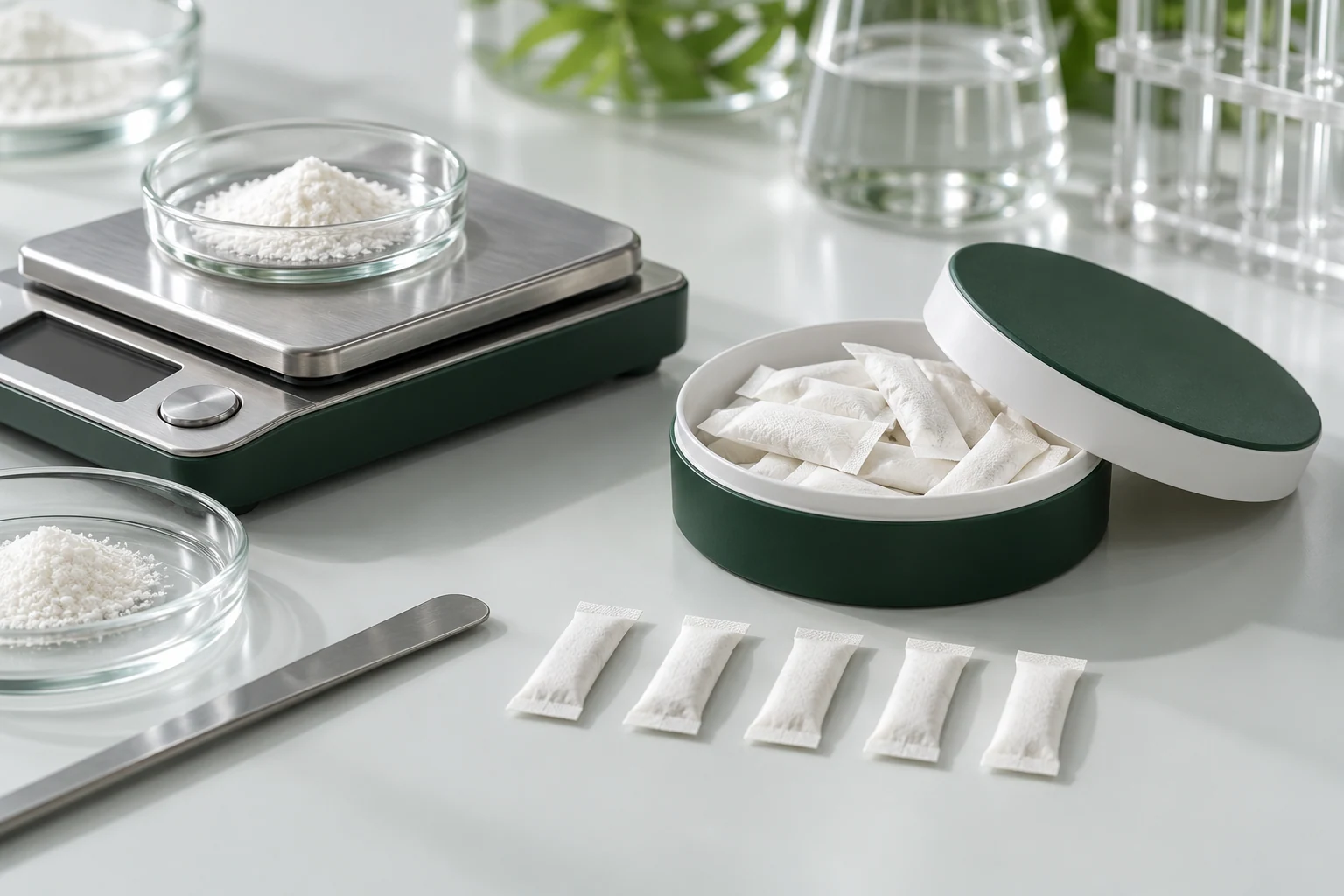
Begin with the limiting ingredient
A formulation discussion becomes more useful when it starts with the ingredient most likely to constrain the product. That may be a mineral with a difficult taste, a botanical with a strong aroma or an ingredient that needs a large serving amount. Adding more candidates before resolving the limiting one can make a brief harder to evaluate.
For each candidate, request the exact form, supplier specification and intended amount. Two materials with the same familiar name can differ in assay, carrier, particle size, solubility or sensory profile. The specification should identify which material is being evaluated so that a later substitute does not quietly change the sample.
Check load against the complete filling system
The pouch contains more than its highlighted ingredient. A development team may need room for a carrier, flavor, sweetening system or other eligible components. The ingredient target must fit the total filling mass while preserving a useful pouch feel and a repeatable filling process. The available space cannot be inferred from the outside dimensions of a can.
Gram-level ingredients deserve particular scrutiny. A concept involving collagen, amino acids or prebiotic material may be limited by the useful amount that can fit into a small pouch. A technically honest outcome may be a revised concept or a different format. A larger ingredient list does not solve that physical limitation.
Evaluate taste in the real base
A flavor sample that tastes pleasant on its own may behave differently in the finished mixture. Minerals can contribute bitterness or metallic notes; botanical materials can bring astringency, color and lingering aroma. A flavor name such as mint or citrus is only the beginning of the sensory brief.
Define the attributes that the sample team should evaluate: initial aroma, sweetness, cooling, bitterness, aftertaste, pouch feel and the experience over the intended use period. Compare samples under the same agreed conditions. When several variables change at once, it becomes difficult to tell which change improved the result.
The source flavor library contains 91 sensory directions. Those names are not ingredient declarations. “Whisky,” “tobacco” or “energy-style” describes a proposed sensory character and does not establish alcohol, nicotine or caffeine content. The actual composition and any exclusion claim need their own records.
Treat moisture and viability as separate questions
Moisture can affect powder flow, aroma, pouch handling and ingredient stability. The appropriate target depends on the actual formula, outer material and package. Ask which characteristic is being controlled and how it will be measured. A single moisture number copied from another product may not describe the risk that matters in this one.
A probiotic concept adds another question: whether the identified organism remains viable under the proposed manufacturing and storage conditions. NIH describes probiotics by genus, species and strain and notes that products labeled probiotic do not all have proven health benefits. A finished-product specification therefore needs more than a generic ingredient name. Any proposed claim must fit the strain, amount, stability and intended use.
Write a decision at the end of feasibility
A useful feasibility review ends with an actionable outcome. It should say what can proceed to a sample, what remains uncertain and which test or document will resolve the uncertainty. It should also say which requests cannot be supported in the proposed format.
- Record the exact material candidates and unresolved supplier questions.
- State the proposed formulation range without presenting it as a consumer dose recommendation.
- Define sensory, filling and packaging experiments.
- Identify ingredient eligibility and claim-review work for the target country.
- Set an approval point before the specification is locked.
This record protects both sides. The buyer knows what the sample is intended to demonstrate, and the development team has a clear reason for each test. A sample can then answer a defined technical question rather than serve as an attractive object with an uncertain purpose.
Questions buyers ask
Is every ingredient suitable for an oral pouch?
No. Ingredient amount, taste, stability, material compatibility, intended use and local eligibility all affect feasibility.
Does a flavor name guarantee the ingredient list?
No. A sensory direction and an ingredient declaration are different. Review the actual flavor composition, carriers and allergen information.
References
Ingredient references inform the questions to investigate. They do not validate the performance or market status of a finished pouch.
Editorial approach: practical development guidance, primary references and a clear distinction between a concept and a validated finished product. About the project team.