
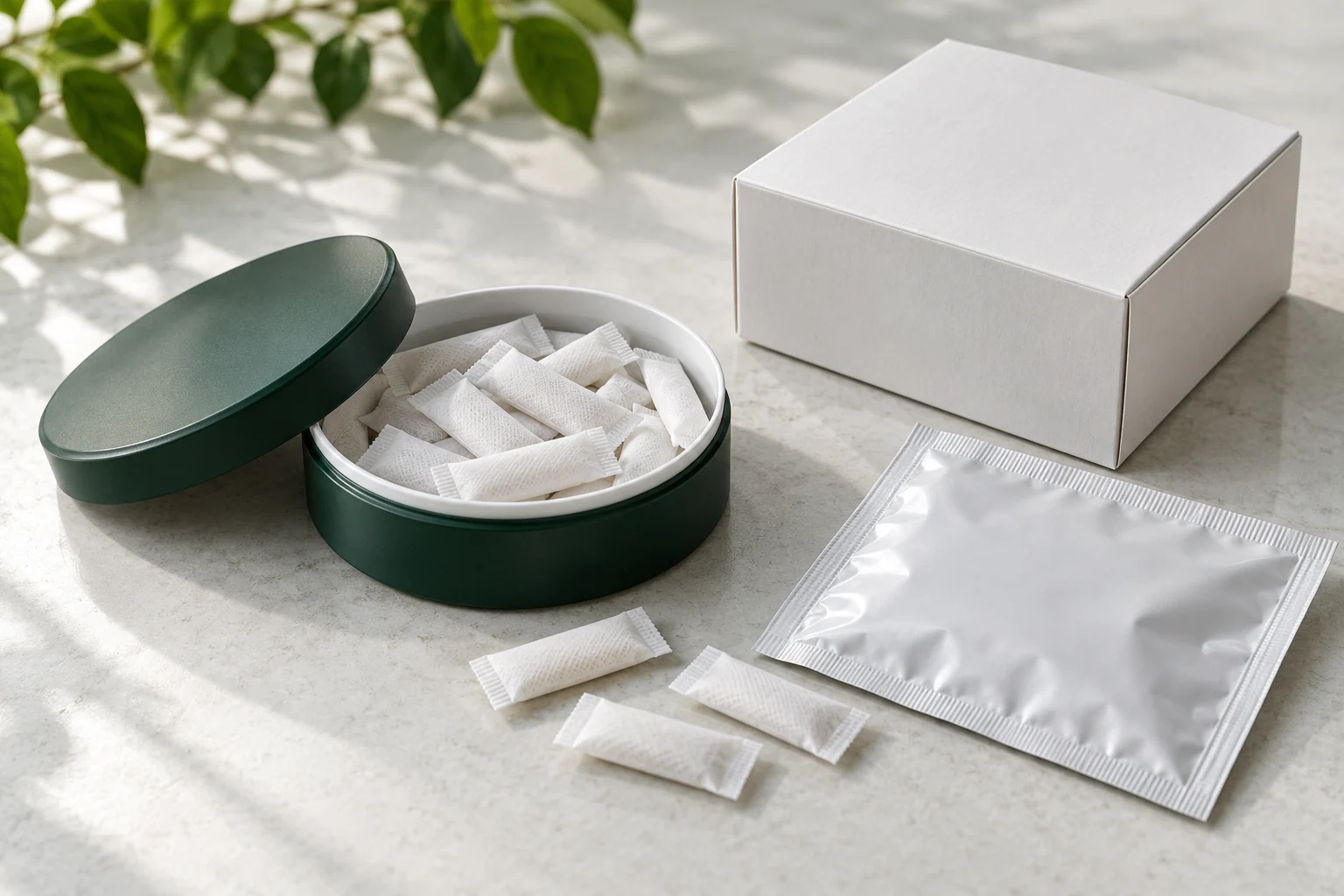
Choose a can by its working requirements
The source packaging catalogue contains 22 can options, with different heights, openings and closure layouts. Start with the required pouch format and pack count, then shortlist a can by its usable space and handling. External dimensions are useful for comparison but do not establish how many finished pouches will fit comfortably.
Keep the supplier code in the brief. Names such as slim round or flip-top can refer to several designs. A code, dimension record and identified sample make the selection less ambiguous. The same discipline applies when artwork is prepared: the drawing and printable area should correspond to the selected physical can.
Test the whole package
A finished packaging system may include a can body, lid, liner, seal, pouch outer material and secondary carton. If the project also requires an individual sachet, that sachet becomes another part of the barrier and handling review. Looking at one component in isolation cannot establish the performance of the complete system.
Ask how the product will be packed, stored, transported and opened. An unopened sealed pack and a repeatedly opened retail can can face different conditions. The study plan should reflect the use and storage instructions being proposed, with clearly identified samples and packaging versions.
A closure described as child-resistant in a source list is not proof of certification. Where such performance is required, confirm the applicable market requirement, test evidence, exact configuration and scope. A visual resemblance to a tested closure does not transfer its result.
Separate flavor retention from ingredient stability
A product can retain an acceptable appearance while an ingredient or aroma changes. Choose the attributes that matter for the specific formula instead of treating “looks fine” as a stability result. Possible review areas include the selected ingredient assay, microbiological criteria, moisture-related behavior, aroma, texture and package integrity.
Not every project needs the same set of tests. A laboratory should help identify suitable methods, sample handling and acceptance criteria. If a method cannot distinguish the relevant material or does not perform in the product matrix, an impressive-looking report may still be unhelpful for the release decision.
Build the shelf-life decision from the study
Do not assign a shelf life merely because a similar can on the market carries one. The formula, raw materials, processing, outer pouch, seal and storage conditions can differ. The development file should explain which evidence supports the proposed period and which questions remain open.
Define the samples, conditions, time points, measurements and decision rules before the study begins. Keep the final artwork consistent with the approved storage instructions. If a component changes later, assess whether the existing evidence still applies rather than automatically carrying the old date forward.
Accelerated work can be useful within a justified protocol, but it should not be treated as a universal shortcut. The relationship between the test conditions and the product’s behavior needs a technical rationale. The commercial specification should make clear what has been demonstrated and what is being monitored.
Keep artwork and release records aligned
The packaging proof needs space for the information required in the destination market. This can include ingredient and allergen information, the responsible operator, lot identification, storage instructions and any applicable warnings. Final wording depends on classification and local review; a generic label copied from another market is a poor starting point.
- Approve the can code, drawing and physical sample together.
- Keep the closure, seal and label versions traceable to the tested pack.
- Define batch coding and legibility checks.
- Record how transport protection and carton requirements were agreed.
- Review the effect of component or supplier changes.
Use the can catalogue to make a practical shortlist, then let evidence narrow the choice. The package should protect the agreed product and communicate its instructions clearly. Its color and print finish can be settled once those working requirements are understood.
Questions buyers ask
Can I assume 20 pouches will fit every can?
No. Confirm actual pouch size, filling mass, headspace and handling with the selected can sample.
Is a source description of child resistance enough?
No. Any required closure performance needs evidence for the exact configuration and target market.
References
- FDA: current good manufacturing practices for food and dietary supplements
- FDA: dietary supplement labeling guide
Ingredient references inform the questions to investigate. They do not validate the performance or market status of a finished pouch.
Editorial approach: practical development guidance, primary references and a clear distinction between a concept and a validated finished product. About the project team.